
Take out your trash for a week and look at what’s inside: food scraps, packaging, bags, plastic wrap. Almost all of it comes from the kitchen. And a good share never should have ended up there: food that spoiled before it got eaten and plastics we used just once.
Cutting waste isn’t only an environmental issue. Food you throw away is money you throw away, and bags and disposable plastic are a purchase you repeat every week. This guide shows you where to start, with data from the U.S. Environmental Protection Agency (EPA) and the U.S. Department of Agriculture (USDA).
First, understand what’s in your trash
- Packaging: according to the EPA, containers and packaging are the largest category of municipal solid waste in the United States: 28.1% of the 292.4 million tons generated in 2018.
- Food: the EPA estimates that 30% to 40% of the U.S. food supply is never eaten, and that food is the single most common material sent to landfills and incinerators.
- Your wallet: the USDA estimates the average family of four loses about $1,500 a year to uneaten food.
One more fact helps put it in perspective: according to the USDA, food decomposing in landfills releases methane, a greenhouse gas with greater warming potential than CO₂.
Step 1: shop with a plan (zero cost)
The most effective way to reduce waste is not to create it. Before you go to the store, check what’s in the fridge and pantry, plan the week’s meals and make a list. That way you buy what you’ll use, not what looks good in the aisle.
A handy trick: put what needs to be eaten first at the front of the fridge and the new stuff in the back. What you can’t see goes bad.
Step 2: store what you buy better
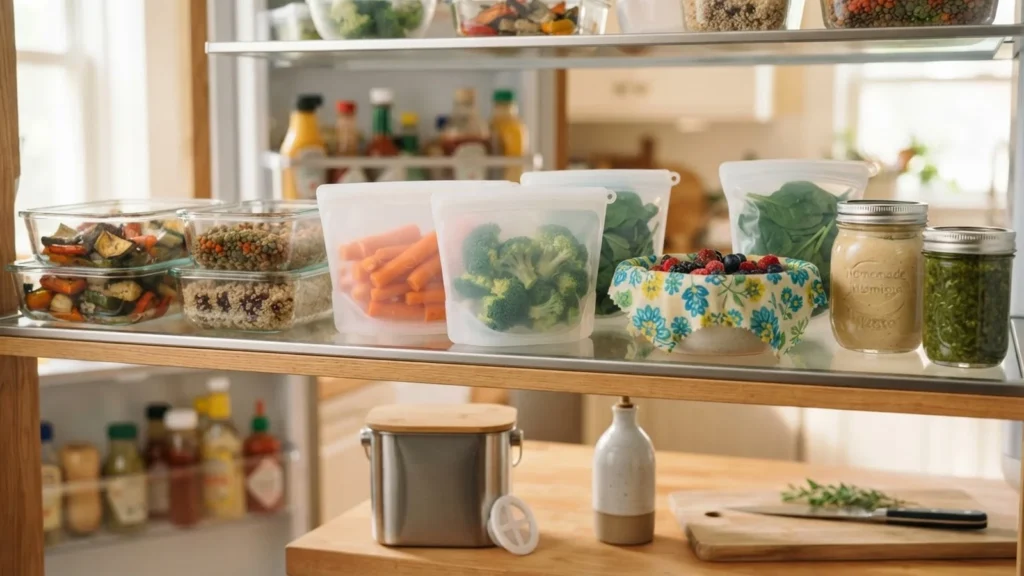
A lot of food gets tossed because it dries out, browns or gets forgotten half-used: half an avocado, the open cheese, half an onion. Storing it well makes it last longer and, along the way, lets you drop single-use plastic:
- For fruit, vegetables, cheese and bread: beeswax wraps, which mold with the warmth of your hands and replace plastic wrap.
- For leftovers, soups and frozen food: reusable silicone bags with an airtight seal.
- For lunch boxes and snacks: reusable bags that stand up and are easy to fill.
Step 3: use your leftovers and understand date labels
Today’s leftovers can be tomorrow’s lunch if you store them well and keep them where you can see them. And before tossing something because of the date on the package, read it carefully: understanding date labels is one of the USDA’s recommendations for preventing food waste at home.
Step 4: compost what you can’t avoid
Peels and scraps you can’t eat can go into a backyard compost bin or a municipal food scrap program if your city has one. Mind the order: preventing waste always comes before composting, because the best food is the food that doesn’t get thrown out.
What we recommend buying
These are the top products from our comparison of reusable bags and beeswax wraps. There you’ll find the full review of each, with materials, care, pros and cons.
This guide contains Amazon affiliate links: if you buy through them, we earn a small commission at no extra cost to you. Approximate prices checked in November 2026. Learn more.
Bee’s Wrap: the plastic wrap replacement

The cheapest way to start. It’s made of GOTS-certified organic cotton, beeswax, plant oil and tree resin, the company is a Certified B Corporation and it can be composted at the end of its life. It’s not for raw meat or liquids, and it lasts about a year. Check price on Amazon · Read the full review.
Stasher 3-pack: the most versatile

Food-grade platinum silicone bags that, according to the manufacturer, handle the freezer, microwave, dishwasher and oven up to 425°F. They come with a lifetime warranty and a TerraCycle recycling program. They’re slow to dry inside. Check price on Amazon · Read the full review.
Zip Top: the easiest to fill

It stands up and stays open while you fill it, is made of platinum silicone in the USA and is dishwasher safe. It’s not oven safe and it’s the most expensive of the three. Check price on Amazon · Read the full review.
Frequently asked questions
Do reusable bags really create less waste?
Only if you use them a lot. Making a silicone bag takes more resources than making a disposable one; the benefit comes when you reuse it hundreds of times. Buy the ones you’ll use every day, not a huge set that sits in a drawer.
What do I do with food I won’t get to in time?
Freeze it before it spoils. Bread, ripe fruit, cooked leftovers and many vegetables can be frozen and used later.
Isn’t recycling enough?
Recycling helps, but reducing comes first: what you don’t buy or throw away doesn’t need recycling. That’s why this guide starts with planning your shopping and storing food well.
The bottom line
Your household waste shrinks mostly in the kitchen: shop with a plan, store what you buy well, use your leftovers and compost what can’t be eaten. To ditch single-use plastic, start with a few beeswax wraps and a couple of silicone bags. Our reusable bag review compares all three options in depth.
Transparency: Havitable is a participant in the Amazon Associates Program. If you buy through our links, Amazon pays us a small commission at no extra cost to you. As an Amazon Associate, we earn from qualifying purchases. That doesn’t buy our opinion: only products with a certification or manufacturer data you can verify make the cut, and we also tell you what we don’t like.
Looking for a gift for the home? See our sustainable home gift guide: 11 certified ideas, sorted by budget.
Sources
- EPA, Guide to the Facts and Figures Report (containers and packaging: 28.1% of municipal solid waste in 2018): https://epa.gov/facts-and-figures-about-materials-waste-and-recycling/guide-facts-and-figures-report-about
- EPA, Sustainable Management of Food (30% to 40% of food goes uneaten; food is the most common material landfilled): https://www.epa.gov/node/142883
- USDA, Food Loss and Waste ($1,500 a year for a family of four): https://usda.gov/foodlossandwaste
- USDA, Why Should We Care About Food Waste? (methane): https://www.usda.gov/foodlossandwaste/why
- USDA, Food Waste FAQs: https://www.usda.gov/foodwaste/faqs
- NEEF, summary of USDA and EPA tips to prevent food waste (planning, storage and date labels): https://www.neefusa.org/node/3688
- Bee’s Wrap, FAQ: https://www.beeswrap.com/pages/faq
- Stasher, product specs: https://www.stasherbag.com/
- Zip Top, product listing at Target: https://www.target.com/p/zip-top-reusable-100-platinum-silicone-container-complete-set-teal/-/A-79722512