
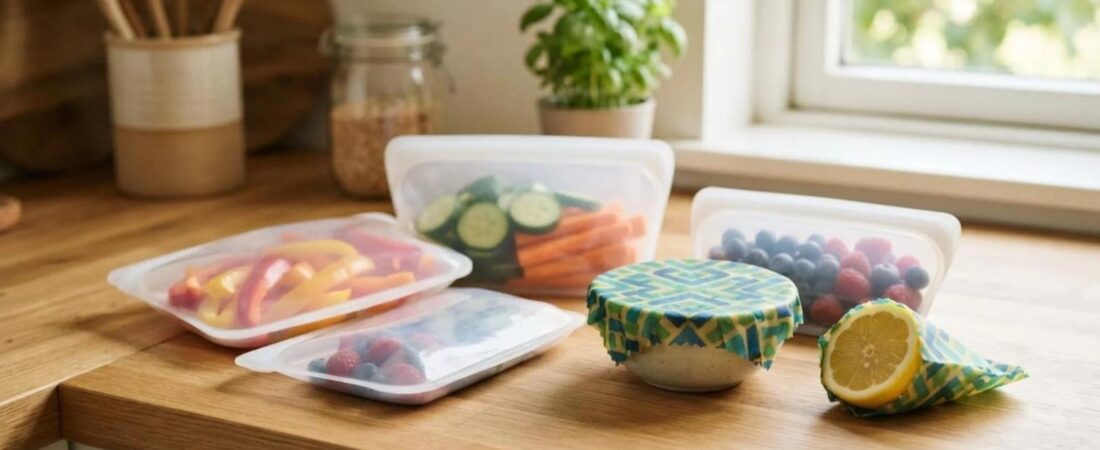
Count how many zip-top bags and how many feet of plastic wrap you go through in a week: the kids’ sandwiches, last night’s leftovers, half an avocado, the cheese that keeps drying out. They’re cheap, which is exactly why nobody thinks about them. But they all end up in the trash after one use, and buying them over and over adds up too.
Reusable alternatives promise to fix both: less trash and less recurring spending. The catch is that Amazon has hundreds of “eco” bags with no information about what they’re made of. For this comparison we chose three products that state exactly what material they use and back their durability with a warranty or manufacturer data: two bags made of food-grade platinum silicone and a set of wraps made of GOTS-certified organic cotton and beeswax.
An honest note before we start: none of these is “zero impact.” Making a silicone bag takes more resources than making a disposable one. The benefit kicks in when you use it hundreds of times. If you buy it and it sits in a drawer, you’ve gained nothing.
Quick comparison
| Product | Best for | Material | Dishwasher safe? | Verifiable backing | Approx. price |
|---|---|---|---|---|---|
| Stasher, 3-pack | Leftovers, freezer and cooking in the bag | Food-grade platinum silicone | Yes | Manufacturer data and lifetime warranty | USD 25–35 |
| Zip Top, 3-bag set | Lunch boxes and snacks, fill without spills | 100% platinum silicone, made in the USA | Yes (both racks) | Manufacturer data | USD 35–40 |
| Bee’s Wrap, 3-pack | Replacing plastic wrap | GOTS organic cotton, beeswax, plant oil and tree resin | No | GOTS-certified cotton; Certified B Corp | USD 15–20 |
This review contains Amazon affiliate links: if you buy through them, we earn a small commission at no extra cost to you. Approximate prices checked in November 2026. Learn more.
1. Stasher: the most versatile, from freezer to oven

Stasher is the brand that made silicone bags popular, and it’s still the benchmark. The bags are made of food-grade platinum silicone and, according to the manufacturer, free of BPA, BPS, lead, latex and phthalates. What sets them apart is what they can handle: freezer, microwave, dishwasher, sous vide and the oven up to 425°F. You can freeze soup and reheat it in the same bag.
The brand estimates that a single bag keeps about 260 single-use bags out of use each year. That’s its own estimate, but reasonable if you use it daily. It comes with a lifetime warranty and, when it finally wears out, it can be recycled through TerraCycle instead of thrown away.
The pack we recommend includes three different formats, including a lunch-style bag, so it’s a good way to find out which sizes you actually use before buying more.
Pros:
- Handles oven, microwave, freezer and sous vide.
- Lifetime warranty and an end-of-life recycling program.
- Airtight seal, great for liquids and marinades.
Cons:
- The pinch seal takes some getting used to, especially for kids.
- Slow to dry inside; leave it open or upside down.
- Pricier per bag than generic silicone bags.
2. Zip Top: the easiest to fill and the best for lunch boxes

Zip Top solved the most annoying problem with reusable bags: filling them without them flopping over. They stand up and stay open while you fill them, then close with a zipper-style seal. Each one is a single piece, with no glue or plastic sliders, which also makes it easier to wash.
The manufacturer says it’s 100% platinum silicone, made in the USA and free of BPA, lead, PVC and phthalates. It’s dishwasher safe (even on the bottom rack), microwave safe and freezer safe. The brand claims one Zip Top can replace more than 5,000 disposable bags; that’s a marketing figure that depends on how much you use it, so don’t take it literally.
Its limitation is clear: it isn’t made for the oven, or for sous vide with the seal submerged. If that’s what you want, Stasher is the better pick.
Pros:
- Stands up and stays open: filling it is a breeze.
- Made in the USA, one-piece and easy to clean.
- Dishwasher safe on either rack.
Cons:
- Not oven safe.
- The most expensive set of the three.
- The “5,000 bags” figure is a marketing promise, not independent data.
3. Bee’s Wrap: the natural replacement for plastic wrap

Here we switch categories. Bee’s Wrap isn’t a bag; it’s a waxed cloth that replaces plastic wrap. You shape it with the warmth of your hands around half a lemon, a piece of cheese or a bowl, and it stays put. The company is a Certified B Corporation, and its original wraps use four ingredients: GOTS-certified organic cotton, beeswax, organic plant oil and tree resin.
With good care they last up to a year. At the end of their life you can compost them or use them as a fire starter, so they leave no plastic waste behind.
The honest part: they have rules. Wash them in cool water with mild soap only, because heat melts the wax. No microwave, oven or dishwasher, and the brand recommends not using them with raw meat or fish, since they can’t be sanitized with hot water. They don’t seal liquids either. They’re perfect for fruit, vegetables, cheese, bread and sandwiches; for everything else, use a silicone bag.
Pros:
- The cheapest option and the one that replaces the most plastic wrap day to day.
- GOTS-certified organic cotton and a Certified B Corp.
- Compostable at the end of its life.
Cons:
- Not for raw meat or fish, or for liquids.
- No heat: no microwave, dishwasher or hot water.
- Lasts about a year; you’ll need to replace it.
Buying guide: 5 things to check before you pay
1. Look for “platinum silicone” and “food grade.” It’s the purest type of silicone and the one serious brands use. If a cheap bag doesn’t say what it’s made of, be skeptical. Some bags that look like silicone are actually PEVA, a plastic that can’t be heated.
2. What you’ll use it for. Freezing and reheating: Stasher. Lunch boxes and snacks: Zip Top. Covering fresh food in the fridge: Bee’s Wrap.
3. The sizes you’ll really use. Start with a small mixed pack. Many people buy a big set and end up using only two sizes.
4. How you’ll wash it. If you don’t have a dishwasher, hand-washing a silicone bag takes a couple of minutes. A bottle brush helps a lot.
5. That you’ll use it a lot. The environmental benefit comes from repeated use. Buying ten bags you never use is worse than sticking with disposables.
Frequently asked questions
Is silicone safe for storing food?
Food-grade platinum silicone is a standard material in kitchenware, and all three brands state their products are free of BPA and phthalates. The key is buying brands that clearly state what material they use.
Do they hold on to smells?
Silicone can retain some odor from strong foods like garlic or onion. Washing it with hot water and baking soda, or letting it dry in the sun, usually takes care of it.
Can I use Bee’s Wrap with raw meat?
It’s not recommended. Since it can only be washed in cool water, it can’t be properly sanitized. Put the meat in a bowl and cover the bowl with the wrap without letting it touch.
How long do they last?
Silicone bags last years with care; Stasher offers a lifetime warranty. Beeswax wraps last up to a year with good care.
What do I do when they wear out?
Bee’s Wrap can be composted. Silicone bags can’t go in regular plastic recycling, but Stasher runs a program with TerraCycle to recycle them.
Our recommendation
If you’re only buying one thing, start with Bee’s Wrap: it’s the cheapest and immediately eliminates plastic wrap, one of the hardest kitchen wastes to avoid. If you also want to ditch zip-top bags, the Stasher 3-pack is the most versatile because it goes from freezer to oven. And if you pack lunches every day, the Zip Top will save you patience: it’s much easier to fill.
The ideal combo for a family is Bee’s Wrap for fresh food and a couple of silicone bags for everything else. With that, the box of disposable bags can disappear from your shopping list.
Transparency: Havitable is a participant in the Amazon Associates Program. If you buy through our links, Amazon pays us a small commission at no extra cost to you. As an Amazon Associate, we earn from qualifying purchases. That doesn’t buy our opinion: only products with a certification or manufacturer data you can verify make the cut, and we also tell you what we don’t like.
Looking for a gift for the home? See our sustainable home gift guide: 11 certified ideas, sorted by budget.
Sources
- Stasher, material specs, oven use up to 425°F and TerraCycle recycling: https://www.stasherbag.com/
- Crate & Barrel, Stasher product listing (materials and maximum temperature): https://www.crateandbarrel.com/stasher-clear-8-piece-bag-set/s115583
- Zip Top, product listing at Target (material, U.S. manufacturing and care): https://www.target.com/p/zip-top-reusable-100-platinum-silicone-container-complete-set-teal/-/A-79722512
- Wayfair, Zip Top spec sheet (not oven safe): https://www.wayfair.com/-/pdp/-zpto1013.html
- Bee’s Wrap, FAQ (ingredients, GOTS certification, lifespan and care): https://www.beeswrap.com/pages/faq
- B Lab, Bee’s Wrap Certified B Corporation profile: https://www.bcorporation.net/en-us/find-a-b-corp/company/bees-wrap/
- Taste of Home, silicone vs. PEVA bags: https://www.tasteofhome.com/collection/reusable-silicone-bags/