
For years, the nonstick pan meant convenience: eggs slide right off, it washes in a minute and you barely need oil. What few of us knew was what that coating was made of. Most traditional nonstick pans use PTFE (better known as Teflon), which belongs to the PFAS family, substances the U.S. Environmental Protection Agency (EPA) describes as highly persistent: they break down so slowly that they build up in the environment and in our bodies, and exposure to some of them has been linked to health effects.
The issue has already reached the law. Since January 1, 2025, Minnesota has banned the sale of cookware with a nonstick coating containing intentionally added PFAS, and since 2026 Colorado, Connecticut, Maine and Vermont have enforced similar bans. There’s no need to panic or throw out all your pans tomorrow, but if you’re buying a new one, it makes sense to choose a PFAS-free option.
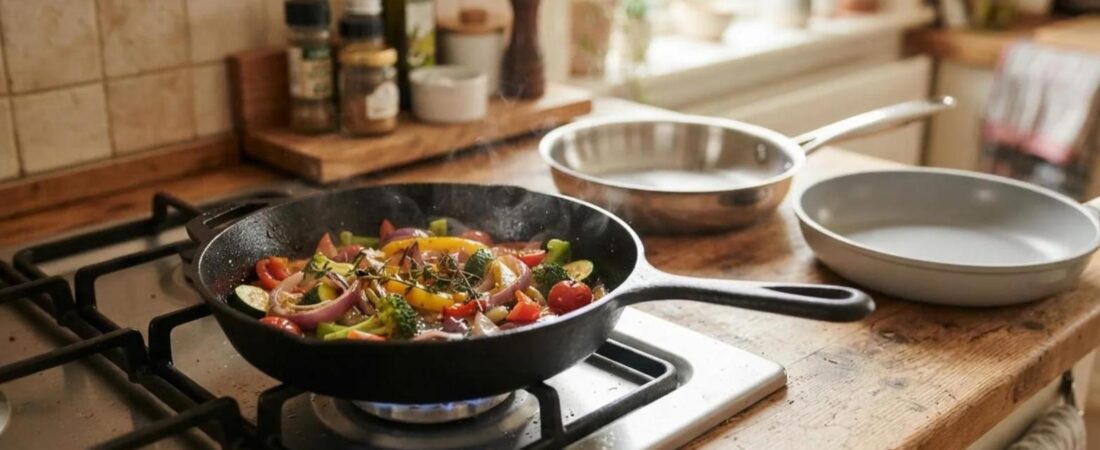
The good news is you don’t have to give up cooking well. There are three proven routes, each with its own strengths and quirks: cast iron, ceramic nonstick and stainless steel. We chose one of each, from brands that clearly state what their pans are made of.
Quick comparison
| Product | Best for | Cooking surface | Nonstick? | Verifiable backing | Approx. price |
|---|---|---|---|---|---|
| Lodge 10.25″ cast iron | Lasting a lifetime and searing meat | Iron seasoned with vegetable oil | Becomes nonstick with use | Manufacturer: made without PFAS, PTFE or PFOA | USD 20–30 |
| GreenPan Valencia Pro 10″ | Eggs, fish and everyday no-stick cooking | Thermolon ceramic over hard-anodized aluminum | Yes | Manufacturer: free of PFAS, PFOA, lead and cadmium | USD 60–80 |
| Tramontina Tri-Ply 12″ | Browning, sautéing and pan sauces | 18/10 stainless steel, uncoated | No | NSF certified; no coating | USD 35–55 |
This review contains Amazon affiliate links: if you buy through them, we earn a small commission at no extra cost to you. Approximate prices checked in November 2026. Learn more.
1. Lodge cast iron: cheap, built to last and nothing weird in it

If you want the simplest pan possible in terms of materials, this is it. According to Lodge, its cast iron has just two ingredients: iron and vegetable (soybean) oil, baked on at high heat at its foundry in South Pittsburg, Tennessee, to create the protective seasoning. The brand says its pans have always been made without PFAS, PTFE or PFOA.
That seasoning is its “natural nonstick,” and it improves with every use: the more you cook, the smoother and darker it gets. It holds a ton of heat, so it’s ideal for searing meat, baking bread or going from stovetop to oven. And at around $25 it’s probably the best cost-per-year pan on the market: well cared for, it lasts generations.
But it’s not for everyone. It’s heavy, the handle gets hot and it needs a bit of care: dry it well after washing and rub on a thin layer of oil now and then so it doesn’t rust. At first, eggs may stick until the seasoning matures.
Pros:
- Just iron and vegetable oil, no synthetic coatings.
- The cheapest of the three and practically indestructible.
- Goes on the stovetop, in the oven and even on the grill.
Cons:
- Heavy, with a handle that gets hot.
- Rusts if left wet; needs maintenance.
- At first it isn’t as nonstick as a ceramic pan.
2. GreenPan Valencia Pro: the most convenient PFAS-free nonstick

If you don’t want to change your habits and what you love about nonstick is that nothing sticks, GreenPan is the most direct option. It pioneered ceramic nonstick, and its coating, called Thermolon, is free of PFAS, PFOA, lead and cadmium, according to the manufacturer. The Valencia Pro line has a hard-anodized aluminum base, works on every cooktop (including induction) and is oven safe up to 600°F.
It’s the ideal pan for the stickiest foods: eggs, fish, crepes, sautéed vegetables. The 12-inch pan from this same line was named the best ceramic nonstick skillet by America’s Test Kitchen in 2022, independent backing that carries weight.
Now, what you should know: ceramic nonstick is more delicate than iron or steel. GreenPan recommends cooking on low to medium heat, saving high heat for searing, and avoiding cooking sprays because they leave residue that ruins the coating. Although it’s dishwasher safe, the brand recommends hand-washing. Over time it loses some of its nonstick ability, like any coated pan. It’s made in China.
Pros:
- Real nonstick, without PFAS or PFOA.
- Induction compatible and oven safe at high heat.
- Independent recognition from America’s Test Kitchen for the line.
Cons:
- Needs low to medium heat and no cooking spray.
- The coating wears over the years; it’s not a lifetime pan.
- The most expensive of the three.
3. Tramontina Tri-Ply stainless steel: the cook’s pan

Stainless steel is the simplest answer to the PFAS question: it has no coating at all, so there’s nothing to flake off. The Tramontina Signature Tri-Ply is made of three layers (18/10 stainless steel, an aluminum core and magnetic stainless steel), which spreads heat evenly across the bottom and sides. It works on every cooktop, including induction, is oven safe up to 500°F and dishwasher safe, and comes with a lifetime warranty.
It’s NSF certified, the organization that evaluates professional kitchen equipment for safety and sanitation. It’s made in Brazil. This is the pan you’ll want for browning chicken, searing steak and using the browned bits for a pan sauce, something a nonstick pan can’t match.
Its big drawback is the learning curve: if you don’t preheat it properly or you move the food too soon, it sticks. It’s not the best for eggs if you’re just starting out. We chose the 12-inch version because it’s the one consistently available on Amazon; if you cook for one or two people, it may feel large.
Pros:
- No coating: nothing to wear out or flake off.
- NSF certified, induction ready and oven safe up to 500°F.
- Lifetime warranty and a great price for the quality.
Cons:
- Food sticks until you master preheating.
- Not the best everyday pan for eggs.
- At 12 inches it may be big for small households.
Buying guide: 5 things to check before you pay
1. Look for what it is, not just what it isn’t. Many pans say “PFOA-free,” but PFOA is just one of thousands of PFAS, and major U.S. manufacturers phased it out between 2006 and 2015 under a program agreed with the EPA. Look for “PFAS-free” or, better yet, a material that is iron, steel or ceramic.
2. How you cook. Lots of eggs and fish: ceramic. Searing meat and oven cooking: cast iron. Browning and pan sauces: stainless steel.
3. Your cooktop. If it’s induction, make sure the pan is compatible. All three on this list are.
4. How much care you’ll give it. Iron needs drying and oil; ceramic needs moderate heat and hand-washing; steel needs almost nothing, just practice so food doesn’t stick.
5. Real lifespan. An iron or steel pan lasts decades. A coated one, even ceramic, will eventually need replacing. Factor that in when comparing prices.
Frequently asked questions
Do I need to throw out my Teflon pans?
Not necessarily. If they’re scratched or the coating is flaking, it’s time to replace them. If they’re in good shape, use them on moderate heat, never heat them empty, and when it’s time to replace them, choose a PFAS-free option.
Is ceramic nonstick the same as “real” ceramic?
No. It’s a mineral-based (sol-gel) coating applied over metal, not a clay pot. That’s why it behaves like a nonstick pan and, like one, wears over time.
Why does food stick to stainless steel?
Almost always because the pan wasn’t preheated or the food was moved too soon. Heat the pan over medium heat, add oil, wait until it shimmers and let the meat release on its own.
What size should I get?
For one or two people, 8 to 10 inches. For families, 12 inches. If you’ll only have one, 10 inches is the most versatile middle ground.
Our recommendation
If you want a single PFAS-free pan and don’t mind a little care, get the Lodge cast iron: it’s the cheapest, the simplest in materials and it’ll last a lifetime. If you won’t give up eggs sliding right off, the GreenPan Valencia Pro is the most convenient PFAS-free nonstick, as long as you use moderate heat. And if you cook a lot and want restaurant-style browning, the Tramontina Tri-Ply is an investment that won’t wear out.
The most practical combo for most homes is simple: cast iron for everything and a ceramic pan just for eggs. With that, you won’t miss Teflon.
Transparency: Havitable is a participant in the Amazon Associates Program. If you buy through our links, Amazon pays us a small commission at no extra cost to you. As an Amazon Associate, we earn from qualifying purchases. That doesn’t buy our opinion: only products with a certification or manufacturer data you can verify make the cut, and we also tell you what we don’t like.
Looking for a gift for the home? See our sustainable home gift guide: 11 certified ideas, sorted by budget.
Sources
- EPA, Our Current Understanding of the Human Health and Environmental Risks of PFAS: https://www.epa.gov/pfas/our-current-understanding-human-health-and-environmental-risks-pfas
- EPA, Fact Sheet: 2010/2015 PFOA Stewardship Program: https://www.epa.gov/assessing-and-managing-chemicals-under-tsca/fact-sheet-20102015-pfoa-stewardship-program
- Minnesota Pollution Control Agency, 2025 PFAS prohibitions (Amara’s Law): https://www.pca.state.mn.us/air-water-land-climate/2025-pfas-prohibitions
- Bryan Cave Leighton Paisner, PFAS in cookware: state-by-state regulations: https://bclplaw.com/en-US/events-insights-news/pfas-in-cookware-state-by-state-regulations.html
- Lodge Cast Iron, Non-toxic cookware: cast iron made without PFAS: https://www.lodgecastiron.com/blogs/story/non-toxic-cookware-cast-iron-made-without-pfas
- Lodge Cast Iron, California AB 1200 Disclosure (made without PFOA and PTFE): https://www.lodgecastiron.com/pages/california-disclosure
- GreenPan, Are GreenPans really healthy? (Thermolon free of PFAS, PTFE, PFOA, lead and cadmium): https://www.greenpan.us/pages/are-greenspans-really-healthy
- GreenPan, ceramic nonstick care tips: https://www.greenpan.us/blogs/the-cooks-journal/how-to-make-your-ceramic-cookware-last-expert-maintenance-tips
- Sur La Table, GreenPan Valencia Pro listing (oven safe to 600°F, country of manufacture): https://www.surlatable.com/pro-7523004-skill-10in-valencia/PRO-7523004.html
- Grove, GreenPan Valencia Pro 12″ listing (America’s Test Kitchen 2022 award): https://www.grove.co/products/valencia-pro-ceramic-nonstick-hard-anodized-fry-12
- Lowe’s, Tramontina Signature Tri-Ply Clad listing (NSF, induction, oven safe to 500°F): https://www.lowes.com/pd/Tramontina-Signature-12-Inch-Tri-Ply-Clad-Stainless-Steel-Fry-Pan/8043006
- Home Depot, Tramontina Signature Tri-Ply Clad 12″ listing (made in Brazil, lifetime warranty): https://www.homedepot.com/p/300873686