

If your home has central heating or air conditioning, the thermostat is the device that most decides how much you pay for power or gas, even though you barely look at it. According to ENERGY STAR, the U.S. government’s efficiency program, heating and cooling take almost half of the average household’s energy bill: more than $900 a year.
The problem with old-school thermostats isn’t that they work badly; it’s that they depend on you remembering to adjust them. We leave home with the AC running, sleep with the heat higher than needed and nobody reprograms anything when the season changes. A smart thermostat does that job for you: it lowers the temperature when nobody’s home, brings it back before you arrive and lets you control it from your phone.
For this comparison we used one simple filter: only ENERGY STAR certified models make the cut. The certification requires manufacturers to prove real savings with data from actual users, not just in the lab. ENERGY STAR estimates that a certified thermostat saves about 8% of what you spend on heating and cooling, around $50 a year, and more if your bills are high.
One important heads-up for readers in Mexico and the rest of Latin America: these thermostats are built for central heating and cooling systems that use a low-voltage (24 V) wall thermostat, the most common kind in the U.S. If your AC is a mini-split with a remote control, or your heat is electric baseboard, they won’t work for you. Below we explain how to check in two minutes.
Quick comparison
| Product | Best for | Needs a C-wire? | Voice assistants | Certification | Approx. price |
|---|---|---|---|---|---|
| Amazon Smart Thermostat | Alexa homes looking for the lowest price | Yes (or adapter kit) | Alexa | ENERGY STAR | USD 50–80 |
| Google Nest Thermostat | Google Home users and homes without a C-wire | In most cases, no | Google Assistant | ENERGY STAR | USD 80–130 |
| Sensi ST55 | Older homes and multi-assistant households | In most cases, no | Alexa, Google Assistant, Apple Home (with C-wire) | ENERGY STAR | USD 75–100 |
| ecobee Smart Thermostat Essential | A color touchscreen and Apple Home | Yes (kit option available) | Siri, Alexa, Google Assistant | ENERGY STAR | USD 130–165 |
This review contains Amazon affiliate links: if you buy through them, we earn a small commission at no extra cost to you. Approximate prices checked in November 2026. Learn more.
1. Amazon Smart Thermostat: the cheapest way to start
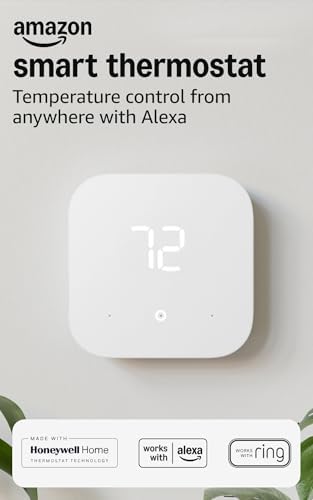
It’s the most affordable entry point to a certified thermostat. Amazon developed it with Resideo, the company behind Honeywell Home thermostats, so there’s plenty of HVAC know-how inside. You set it up and control it from the Alexa app, which also walks you through installation step by step.
Amazon estimates it can help you save up to $50 a year, in line with ENERGY STAR’s general estimate. Keep in mind that’s the brand’s figure, and your actual savings depend on your climate, your home and how you program it.
The big condition is the C-wire (the “common” wire that gives the thermostat constant power). This model needs one, period. If your system doesn’t have it, there’s a version sold with an adapter kit, but it’s one more installation step. It also only works with Alexa: if your home runs on Google or Apple, it’s not for you. It has no microphone or speaker, so you talk to it through an Echo or another Alexa device.
Pros:
- The lowest price of the four, especially during sales.
- Honeywell Home technology and ENERGY STAR certification.
- Guided installation in the Alexa app, with a compatibility checker.
Cons:
- Requires a C-wire or the adapter kit.
- Works with Alexa only.
- Basic display, with no room sensors or advanced features.
2. Google Nest Thermostat: the easiest install in homes without a C-wire

Google’s Nest is the one that best solves the C-wire headache. According to Google, it’s designed to work without that wire in most homes. There are exceptions: heating-only, cooling-only, zoned and heat pump systems do need a C-wire or the Nest Power Connector, an accessory Google sells for $24.99 that installs at your HVAC equipment.
On savings, it has the strongest data behind it. Two independent U.S. studies, plus Google’s own analysis, found users saved an average of 10% to 12% on heating and about 15% on cooling. Google notes that individual savings aren’t guaranteed, so treat it as a benchmark, not a promise.
To avoid confusion: this is the plain Nest Thermostat, not the pricier Nest Learning Thermostat. It doesn’t learn your schedule on its own; you set a quick schedule and the app suggests tweaks to use less energy (a feature called Savings Finder). For most homes, that’s more than enough.
Pros:
- Works without a C-wire in many installations.
- Savings backed by independent studies.
- Low-key design and a very polished Google Home app.
Cons:
- Built for the Google ecosystem; if your home revolves around Alexa or Apple, other models fit better.
- Some systems (heat pump, zoned) need the Power Connector, sold separately.
- It doesn’t learn on its own like the Learning model.
3. Sensi ST55: the all-rounder for homes with older wiring

The Sensi is the least flashy option here and, for that very reason, one of the most practical. No color screen, no showroom design: a big, clear display, physical buttons and a simple app. What it does have is compatibility: according to the manufacturer, it doesn’t need a C-wire in most installations (it does for heating-only or cooling-only systems), because it can run on AA batteries.
It’s also the most open to different ecosystems: it works with Alexa, Google Assistant, Samsung SmartThings and Apple Home, though Apple Home requires a C-wire. The brand claims about 23% HVAC energy savings, calculated by comparing run time across a nationwide sample of its users. That’s a manufacturer figure, so we take it with caution; the independent backing is its ENERGY STAR certification.
One detail we like: it isn’t compatible with electric baseboard heat, and the brand says so clearly. We’d rather have that than a generic “works with everything” promise.
Pros:
- No C-wire needed in most cases.
- Works with nearly every voice assistant.
- Great price for what it offers.
Cons:
- Basic design, no color touchscreen.
- Apple Home only works with a C-wire.
- The 23% savings figure is the brand’s own calculation, not an independent study.
4. ecobee Smart Thermostat Essential: the most complete if you want a touchscreen

ecobee launched the Essential in 2025 as its entry-level model at $129.99, going head to head with the Nest. It inherits much of what makes its pricier models appealing: a color touchscreen, a highly rated app and compatibility with Siri (Apple Home), Alexa and Google Assistant. It’s the natural choice if everything in your home runs through your iPhone.
The brand claims up to 23% annual savings on heating and cooling, and says the thermostat pays for itself within months. Again, those are ecobee’s figures; what you can verify is its ENERGY STAR certification. For homes without a C-wire, ecobee offers a Power Extender Kit for DIY installation. It comes with a 3-year warranty.
Why isn’t it higher on the list? Price. It’s the most expensive of the four, and if you don’t care about a color screen or Apple Home, the Nest or the Sensi do the saving for less money. And room sensors, a big part of ecobee’s appeal, are sold separately.
Pros:
- Color touchscreen and a very complete app.
- Works with Siri, Alexa and Google Assistant.
- 3-year warranty and a kit for homes without a C-wire.
Cons:
- The most expensive in this comparison.
- Room sensors are sold separately.
- The brand’s savings figures aren’t independent.
Buying guide: 5 things to check before you pay
1. Make sure your system is compatible. Take the cover off your current thermostat. If you see thin wires connected to lettered terminals (R, W, Y, G, C), you have a low-voltage system and these thermostats will work. If you see thick wires or your thermostat says 120 V or 240 V, it’s line voltage and they’re not compatible. Every brand has a compatibility checker on its website: use it before buying.
2. Check for a C-wire. Look for a wire connected to the “C” terminal. If there isn’t one, the Nest and the Sensi adapt best; for Amazon and ecobee you’ll need to add a kit.
3. Your voice assistant. It sounds minor, but it shapes the daily experience. Alexa: Amazon or Sensi. Google: Nest or Sensi. Apple: ecobee (or Sensi with a C-wire).
4. The ENERGY STAR label. It’s the only way to know the savings were measured with real data. Plus, many U.S. utilities offer discounts or rebates only for certified thermostats. Before buying, check your power company’s website; sometimes the rebate covers a big chunk of the price.
5. How you’ll use it. A thermostat saves when you let it work. Turn on schedules, away mode and savings suggestions. If you only use it as a remote control, you’ll save little.
Frequently asked questions
How much will I really save?
It depends on your climate, your home and your habits. As a reference, ENERGY STAR estimates about 8% of heating and cooling costs, around $50 a year, and the Nest studies found 10% to 15%. If you already programmed your thermostat carefully, savings will be lower; if you left it at one setting all day, they’ll be higher.
Can I install it myself?
In most cases, yes. All four brands offer guided installation in their apps, and it usually takes 30 minutes to an hour. If you need to run a new C-wire, or your system is a heat pump with auxiliary heat or dual fuel, call a technician.
I live in Mexico. Will any of these work?
Only if your home has central heating or cooling with a low-voltage wall thermostat, which is uncommon outside the U.S. and Canada. With mini-splits, the usual alternative is a smart infrared controller, which is a different category. Also check that the model’s app and support are available in your country before buying.
Does it work if the internet goes down?
Yes. All four keep controlling the temperature on their schedule and from the device itself. Without Wi-Fi you lose remote control from your phone and cloud-based features.
Is the Nest Learning worth it over the regular Nest?
Only if you want it to learn your schedule without setting it up and you’re willing to pay quite a bit more. For saving energy, the regular Nest Thermostat with a well-set schedule does almost the same job.
Our recommendation
If your home has no C-wire or you use Google Home, get the Google Nest Thermostat: it has the best-documented savings and the fewest installation headaches. If you already live with Alexa and have a C-wire, the Amazon Smart Thermostat is hard to beat on price. The Sensi ST55 is the safe bet for older homes or households with several voice assistants, and the ecobee Essential makes sense if you want a touchscreen and everything runs through your iPhone.
Either way, before you pay, check your power company’s website: with an ENERGY STAR thermostat rebate, the savings start on day one.
Transparency: Havitable is a participant in the Amazon Associates Program. If you buy through our links, Amazon pays us a small commission at no extra cost to you. As an Amazon Associate, we earn from qualifying purchases. That doesn’t buy our opinion: only products with a certification you can verify make the cut, and we also tell you what we don’t like.
Looking for a gift for the home? See our sustainable home gift guide: 11 certified ideas, sorted by budget.
Sources
- ENERGY STAR, Smart Thermostats (certification, criteria and estimated savings): https://www.energystar.gov/products/smart_thermostats
- ENERGY STAR, certified smart thermostats Product Finder: https://www.energystar.gov/productfinder/product/certified-connected-thermostats/results
- Google Nest, Explaining Nest thermostat savings: https://support.google.com/googlenest/answer/9247497
- Google Nest, Nest Power Connector: https://support.google.com/googlenest/answer/10523126
- Google Nest, energy savings white paper (Pennsylvania PUC): https://www.puc.pa.gov/pcdocs/1359738.pdf
- Reviewed (USA Today), Amazon Smart Thermostat review: https://reviewed.com/smarthome/content/amazon-smart-thermostat-review
- Sensi, ENERGY STAR certification and estimated savings: https://sensi.emerson.com/en-us/blog/sensi-smart-thermostats-earn-energy-star-certification
- Tom’s Guide, ecobee Smart Thermostat Essential launch and warranty: https://www.tomsguide.com/home/smart-home/ecobee-launches-new-cheaper-smart-thermostat
- ecobee, Smart Thermostat Essential: https://www.ecobee.com/en-ca/smart-thermostat-essential-ces